Whether you're Coaching Minor Hockey in
Canada, or Coaching Youth Hockey in
the USA or around the world - Hockey Made Easy has been helping
Coaches, Parents and
Players
play winning hockey since 1995
"How to Conquer Your Competition - And
Win More Games"
… secrets for turning your
hockey team into a winner in just 10 days
by Hockey Canada Award
winner and Author John Shorey
9 facts
you must know to become a winning Youth Hockey Coach, Player or
Team.
Why
do some Minor Hockey Teams win
over 80% of their games
while others try
everything possible and are lucky to win 25% of theirs? What if there
was an easy
way you could improve your Team’s winning percentage by
15%,
25% --
even
40%
or more, how much higher would that improve your position in the League
standings?
Consider the following
questions to see if any
of these hockey problems apply to you, or your Team,
and whether you should continue reading this hockey article or not.
Does it
frustrate you as a coach that
your players are playing at only a fraction of their
full potential and your losses are
starting
to pile up?
Is your Team
allowing too many goals
against by giving up numerous
odd man rushes, or allowing
opposing forwards to stand uncovered
in front of your net?
Does your Power Play (PP)
struggle, or your Penalty
Killing (PK) suck?
Do you blow a fuse when your
players take bad or undisciplined penalties in the
offensive zone and it results in a power play goal against you?
Do your forwards miss
quality-scoring opportunities because they lack finishing skills?
Do your defencemen usually get
beaten on 1 on 1, or 2 on 1 situations leading to quality scoring
chances for the opposition?
Do you see red when your Team
blows a 1- goal lead late in the game?
Does your goaltender give up soft
or bad goals at inopportune times?
Does it infuriate you that you
could be making five times as much, or more, improvement with your young
Hockey Team if you only had more practice time?
If this sounds a little or a lot like
you, your players, or your Team, and you truly want to correct
these problems, develop more skills to turn your season around and
compete with, then conquer the top teams in your League, you just might
want to continue reading because the solutions to these problems are
contained within this article!
If you could read just one article about
how to turn a young inexperienced Team, or an underachieving
talented Team playing under .500 hockey, into a fine
tuned winning machine, this is it.
I dare you to read this entire article
and not change the way you play, practice, or coach youth hockey.
I will even promise, that if you use
the suggestions contained throughout this article, you will win more
games, lose fewer games, …perhaps even winning a playoff Champions
|
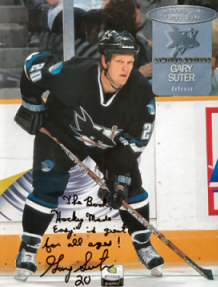
“A
Great Book for all ages”
that’s what former NHL Rookie of the Year
Gary Suter
calls the “Hockey Made Easy Instruction
Manual ”
|
Who these solutions will help?
If you are…
(a) a Minor/Youth Hockey Coach working with Beginners, Initiation,
Novice/Mite, Atom/Squirt or Peewee players, playing in House League
or on the
“AAA” Travel Team
(b) a young Male or Female Youth Hockey Player between
5 and 15 years of age wanting to improve your hockey skills
and knowledge
(c) a parent or grand parent wanting to help your young
(grand) son or daughter play better hockey
…you are about to find out the most often overlooked secret to start turning
your young hockey Team into a winner.
What are the two most
important elements for a winning hockey team?
Have you ever wondered what the two most important elements are for a
Hockey Team, that when initiated would single-handedly account for more wins
than any other skill?
I would tell you, without a doubt – it’s the ability for coaches (or
parents) to teach individual and team hockey skills. That’s because
the most important factors for any hockey team to get on the winning track
are…individual skill development and specific Team systems. These are
only learned and improved upon by practicing them.
Practice Makes Perfect
Listen closely. If you do not practice, you will not win many
hockey games. You will not improve as a player and your Team will be
destined to be in the bottom half of the standings. Remember the saying
“Practice Makes Perfect” this is especially true for young hockey Teams
and young hockey players. Teams must practice at least once a week. Twice is
even better, as it will speed up the improvement process for both teams and
players.
N.B. Playing hockey games does not improve your skills; practices do,
and winning or losing a game is based on what you learned and
perfected at your practices.
In the next few minutes, I’ll tell you how to easily master the
challenge of finding extra practice time, turning loses into victories,
turning non-goal scorers into scorers, turn error prone defencemen into rock
solid defenders and change shaky goaltending into a steady puck stopping
art. All of this can be accomplished by running specific Skill
Development practices.
I’ll show you how to progressively train your team from Tryout camp
to the end of your Playoffs simply by reading on.
Here’s what’s possible for your Team:
(a) Imagine what it would be like if your team could score 5 goals every
game. Would that inspire your players?
(b) How would you like your Team’s forechecking and backchecking systems
improved to such a degree that your goals against were cut in half.
Would that help make your team more competitive?
(c) What if there was a way you could improve your Power Play and Penalty
Killing success rate by just 10%, 15% or 20%, would that cut your
loses
and add a few more wins in the standings?
(d) Imagine what you could accomplish with 2- 3 hours of additional
prime time practices every week. Would you have more time to
teach skills,
correct errors that led to eventual loses and teach
your players how to protect a 1-goal lead late in the game?
(e) Think for a moment how extra practices would give you and your
assistant coaches the time you need to teach young male or female House
League or “AAA” Travel Hockey Players the basic skills,
systems and strategies required to turn some loses into victories
and move your Team
into the top half of the standings. Practices and Team
meetings would also help you prepare your Team both
mentally and physically for the
exciting but pressure-packed year-end Playoffs.
But where
do you get this extra Practice Time?
… I’ll
tell you in a moment.
|
Kirk Muller Former Captain of the
Stanley Cup Champion
Montreal Canadians and now an Assistant Coach
with the
Canadians
calls “Hockey Made Easy” a
Great Book!
|
The
Secret for Success … Off-Ice Practices
Depending on
your definition of success, i.e. players having fun, players
improving their skills and knowledge, your team moving into the top half of
the League standings, or the ultimate success, your team winning the League
Playoff Championship. The following information will help solve many of
these challenges. …but how you ask?
Well, there’s a specialized can’t miss program available I’ll tell you about
shortly for running successful skill development off-ice practices.
When this program is followed, anyone can achieve hockey success.
The very first thing coaches must do if you truly want to turn your season
around, become more competitive, or win more games is to book/rent a large
hall or school gymnasium for 2-3 hours every week for a minimum of
4-6 weeks. The more weeks you practice, the more your players
will learn, the more your team will improve and the more games you will win.
Off-Ice Practices will also act as a catalyst for bonding your players into
a cohesive hockey Team. I know of many winning coaches who book 20 weeks in
a gymnasium at the start of every season.
The hall or gymnasium’s rental cost will be only a fraction of
prime-time practice ice and with any luck you can book it in prime time from
around 5.30 to 8:30 pm. possibly the same day each week. Parents, team
sponsors, 50/50 draws or other fund raising events will help pay for any
rental cost.
At Off-ice Practices, Head and Assistant Coaches can conduct small group
teaching sessions, then demonstrate specific skills, followed by practice
opportunities for every player on the hall or school gymnasium floor.
Players can rotate from station-to-station after a specific period of time
but I will leave that to the coaches running the off-ice practice. Conclude
your practice with a controlled ball hockey scrimmage at the end of the
evening to provide some fun for your players and they will be eager to
return next week.
In a gymnasium or large hall you will have lots of time, and lots of space,
to do conditioning drills at the start of the session, then, when your
players are tired out and ready to listen, you start to explain,
demonstrate and practice basic shooting skills for accuracy and velocity,
creative passing plays, quality scoring plays, effective clearing and
breakout plays, aggressive forechecking and backchecking systems, power play
and penalty killing strategy etc. Everything that is necessary to play
winning hockey and perhaps even challenge for the Playoff Championship.
Here’s a valuable tip. If your players get board with too much theory
and not enough action, have some extra shooting drills or a competitive
shoot-out competition between lines, forwards vs defencemen etc. All
players get primed up trying to score on a goalie, and this skill will have
a positive carry over effect for your League games.
You will be astounded with the individual and team skill development
you will accomplish with every single player in a very short
period of time by using this time-tested progressive off-ice method.
The prime reason off-ice practices are so successful is because you
and your coaches have the time to show your players how to execute the skill
correctly. There is no rush, like on the ice, where time is of the essence.
You can take your time and explain it slowly, demonstrate the skill
step-by-step, practice it again and again, then give your players positive
feedback or make any corrective suggestions or adjustments to improve the
skill.
Are off-ice practices really the secret strategy to cut down hockey
loses, develop individual skills and jump-start your Team’s overall improved
play? Can this really be possible? You want to believe it!

But first, you’ll need the specific
program consisting of hockey information and the
time-tested teaching sequence to instruct your young players.
That’s where the “Hockey Made Easy Instruction Manual” and “The Parents
and Coaches Teaching Guide” comes to your rescue. You don’t have to
re-invent the wheel because it’s all laid out for you in a
step-by-step sequence in the Manual and the Teaching Guide.
You don’t believe me; you think this is a lot of bull. How could a young
team be transformed into a winner in such a short period of time by
participating in off-ice practices?
Well, I’ve done it, I’ve seen other progressive coaches do it;
coaches have even e-mailed me over the past 12 years telling me about
their success using my off-ice method, so I know it is very possible!
Try it and you‘ll see how much improved your players will play after
using this system. As a matter of fact, one weekend after I’d taught my
12 students different scoring methods, everyone of them, that’s
100%, scored at least 1 goal during their next League game.
The truth is, Off-Ice Practices are fun, they will increase
your wins, reduce your loses, make you a better player and
a more competitive team.
|
I just want to tell you that I ordered your e-book and received it within
hours (on a weekend too, thank you so much). I have perused it and I have to
tell you that I consider it the BEST USE of MONEY I have EVER spent in
sports (and I've played a lot of sports). I actually think it may be the
best purchase of my life value-wise
(and I am 34!). I am not kidding.
Thank
you for pulling so much knowledge together in such a clear format, and for
making it available at such an awesomely affordable price. I will recommend
it whenever I can. You made my day, BIG TIME!
Thanks Again. I can't wait to implement the knowledge with the girls' team I
coach, and for my own development in the game.
-
T. Perry -
Vancouver BC
|
About the Author
I’m John
Shorey and the Author of 4 Hockey Instruction Manuals. I started my hockey
career many years ago in the Minor Hockey system in Canada. I played on
numerous House League and Travel Teams before moving to Junior “A” hockey as
a 16 year old. I won the League’s Rookie of the Year award and was invited
to play Major Jr. “A” Hockey for the Toronto Marlboros, the top Junior farm
team of the NHL Toronto Maple Leafs. A very serious broken leg prevented my
participation, and it took over 7 months to heal. The following winter I
returned to Jr. “A” Hockey signing with the Brockville Braves, the Junior
“A” farm Team of the NHL’s Chicago Black Hawks.
I finished
second, then first, in team scoring in my final 2 years of Junior. I
averaged almost 2 points per game playing 3 seasons of Junior “A” Hockey in
Canada.
Upon my graduation from Junior “A” hockey, I went to Europe and played 2
seasons of professional hockey.
When I returned to Canada I started coaching Junior “B” Hockey and coached
for 13 seasons as well as
becoming GM and owner of the franchise.
Following my coaching career I was elected President of the Rideau-St.
Lawrence Junior “B” Hockey League, a position I have held for 27 consecutive
seasons.
Other highlights of my hockey career include winning a Junior “B”
Championship as Head Coach, a Coach of the Year Award, a Hockey Canada
Junior Hockey Recognition Award, an Ottawa District Hockey Association
Recognition Award and being inducted into the Brockville and Area Sports
Hall of Fame.
Why did I write
4 hockey manuals?
Well, after watching the somewhat poor quality of hockey played in many
Minor and Junior programs, I wanted to do something about it. So in
1994, I decided to write an easy-to-read, easy-to-understand
instructional book called “Hockey Made Easy.” The goal of the book was
to help young players, their parents and coaches understand, then teach
the basic rules, skills, systems and strategies of hockey.
The first manual was published in October of 1995; it contained just 138
pages and was an instant success.
Since then it has been reviewed, revised and expanded 8 times as new
hockey rules were introduced to increase overall speed, allow 2 line
stretch passes, and increase more shooting & scoring opportunities. This
latest 8th Edition Manual now contains 225 fact-filled
instructional pages.
In total there are now 4 e-book Manuals in pdf format to help Coaches,
Parents and Players learn how to coach, teach or play a competitive
Canadian style Minor hockey game.
1. The 225 page, “Hockey Made Easy Instruction Manual” - contains
everything a coach, player or parent needs to know for teaching young
male or
female players the skills, systems and strategy for playing Minor
or Youth Hockey.
2. The 30 page, “Parents and Coaches Teaching Guide” - is used for
teaching young male or female House League to “AAA” players the skills
and
rules required to play hockey correctly and safely. The
teaching can be done either at home by a parent, or at the rink or in a
gymnasium by
the coaches.
3. The 35 page, “Seasonal Instruction Plan for Minor/Youth Hockey
Coaches” - includes running a successful tryout camp, skills evaluation
and
selection of players, teaching basic and complicated skills
over the course of an entire hockey season, playoff preparation and a
winning strategy.
4. The 48 page, “Coaches Practice Guide” - explains how to run organized
practices by rotating small groups of players for different skill
instruction by
using a variety of drills. It includes selection criteria for
Assistant coaches, a full season practice plan overview, 6 complete
practice plans, and a
player evaluation form for Forwards, Defencemen and Goaltenders.
Over these past 12
years the Hockey Made Easy Manuals have helped thousands upon thousands
of Youth Hockey coaches, parents and players from around the world learn
how to play
hockey games correctly and safely … and they can help you.
|
I highly recommend the purchasing of
"Hockey Made Easy.”
If every Minor and Youth hockey player understood the basic content of this
great instructional manual, it would make their transition to
Junior Hockey
programs that much easier".
Wilf Johnston- Former Hockey Coach
Brockville
Junior “A” Braves and
Big East Fred Page Cup
Champion and Canadian Jr. “A”
Finalist
|
9 facts you need to
know to turn your Team from being a pretender into a contender
1. Tryout Camp – the winning formula for picking the right players for
your Hockey Team
Coaches and Assistant Coaches must evaluate each player’s hockey talent at
tryout camp by using specific game like drills, scrimmages and exhibition
games, then select a combination of Team oriented and skilled players with a
winning attitude, good character and who possess the following hockey
skills:
Selecting Your Forwards
(a) Select some Forwards with – Quality Shooting and Scoring Skills
(b) Pick some with – Creative Playmaking and Passing ability
(c) Choose others with – Physical Checking/Grinding skills i.e. their
ability to create turnovers & recover loose pucks in the corners and along
the
boards
(d) Teams need at least 2 balanced scoring lines to succeed, 1 line
will not do it against the top teams.
(e) Top lines are usually composed of a gifted goal scorer, a creative
playmaker and a tenacious checker.
(f) Remember, if you choose all goal scorers, who is going to pass
them the puck and who is going to go into the corners to dig out loose pucks
or
create a turnover?
Picking Your Defencemen
(a) Pick some “D” with offensive puck carrying, stickhandling,
shooting & scoring skills
(b) Choose others with good defensive skills; i.e. preventing goals
by playing 1 on 1’s, and 2 on 1’s correctly, aggressive corner work,
competent
blanket like coverage in front of your net and shot
blocking skills.
(c) Pair an offensive “rushing” defenceman with a “stay home”
defensive defenceman to ensure one is always back to defend against any rush
(d) Defencemen must have lots of courage. Make sure you take this into
consideration when selecting them
(e) Remember, if you pick all offensive defencemen who is going to be back
to defend against the rush?
Choosing Your Goaltenders
(a) Your goaltender is the backbone of your team and most coaches believe
your most important player. You must take your time selecting a
goaltender and once you do s/he will need exclusive
instruction from you or one of your Assistant Coaches at all practices and
games.
(b) Choose goalies with good puck stopping skills and who can almost
always stop the first shot. They must understand the theory of cutting the
angle and setting themselves square/90 degrees to the
shooter and puck in order to stop initial shots and control rebounds.
(c) Good goalies have quick hands and feet and can keep the game close,
always giving your team a chance to win.
(d) Big and tall goaltenders cover more area of the net than smaller
goaltenders and if both are equal in puck stopping ability, I suggest
you pick
the bigger one.
2. Run Organized On-Ice and Off-Ice Practices
The purpose of a practice is to teach basic hockey skills, systems
and strategies by using specific non-complicated drills to prepare for an
upcoming game, or to correct errors made in previous games.
Head and Assistant Coaches must run organized, up-tempo, on-ice and
off-ice practices teaching specific skills, systems and strategies to turn
an underachieving or losing Team into a winning one.
Try to keep your players constantly moving, not standing around too long
waiting for their turn in a drill. Divide the ice or floor into sections,
then break the team into small groups of 5 and rotate players from
station-to-station through out your practice time period. End every practice
with a controlled scrimmage to provide some fun.
3. Objectives of Offensive, Defensive and Transitional Hockey
During the
early weeks of the season, coaches must review with their players either at
a Team meeting or at a practice the objectives of:
“Offensive
Hockey” - skills used trying to score a goal when your team
controls the puck. This includes carrying the puck, passing and head manning
the puck, or shooting it in deep if over the Red Line then either
forechecking to regain possession of the puck, or if you have possession in
the corner, possibly cycling the puck behind the net trying to create a 2 on
1 situation and a high percentage Goal scoring opportunity.
“Defensive
Hockey” - skills used trying to create and recover loose pucks by
winning the 1 on 1 battles in the offensive zone. Eliminating odd man rushes
by covering the wide winger and preventing goals against when the
opposition controls the puck in the Neutral and Defensive zone. Never leave
an opponent uncovered in front of your net; as this is the prime shooting
area where most goals are scored.
“Transitional Hockey”- all players young and old need to understand
and play a lightning fast transitional game of going from Offensive
Hockey to Defensive Hockey quickly with every change of possession of the
puck. And visa versa, going from Defensive Hockey to Offensive Hockey by
counter attacking as soon as your Team regains possession of the puck and
starts an offensive rush up the ice.
Players must also understand at a young age that preventing goals
is just as important as scoring goals and will be a major contributor to
winning hockey games.
4. Specific Playing Rules
Many young hockey players do not understand the basic rules of hockey
and they are much too shy to ask the coaches for an explanation. They just
nod their head signifying they understand when really they don’t.
Coaches must realize this and should explain to their players in very simple
terms or by drawing diagrams on a portable rink board (a picture is worth a
thousand words) so their players understand what causes and what the
consequences are of the following rules:
(a) Off-sides, Delayed Off-sides and Intentional Off-sides
(b) Icing and Non Icing of the puck
(c) Penalties, explain and demonstrate what you can do and cannot do
to avoid taking a 2 minute Minor, a 5 minute Major, a Game ejection Match
Penalty or a 10-minute Misconduct Penalty.
(d) The new interpretation of the rules by a Referee states, “the
hockey stick must only be used for playing the puck, it is not to be used to
impede
the progress of the puck carrier” or you’ll get a
penalty
(e) Also, you cannot bodycheck a player without the puck, if you do
and get caught by the Referee you will also receive a penalty.
5. Teaching Basic Hockey Skills
When coaching young players how to play winning hockey, they’ll need to be
taught by explaining, demonstrating, then practicing the following
specific skills from the 5 basic skill groups:
(a) Skating- including forward, backward, stops, starts, turns,
crossovers and 180 degree pivots
(b) Puckhandling, Stickhandling and Deking
(c) Passing and Receiving on your forehand and backhand. It is
imperative to teach the 8 basic types of Passes. These should be explained
when
they are used, then demonstrated and finally practiced.
(d) Shooting and Scoring Skills –explain the 8 basic shots for
scoring goals and the 5 prime scoring locations on the goalie. Demonstrate
several;
scoring plays by way of shooting, passing etc. If
Players are taught correctly they will go from single digit goal scorers to
double-digit scorers.
(e) Checking/Grinding Skills - used to create turnovers and recover
loose pucks. Demonstrate and practice Stick Checking Skills, then Body
Checking Skills if allowed, by using your hip or
shoulder to check (physically knock) the puck carrier off the puck creating
a turnover or a loose
puck.
6. Systems
and Strategies used to Win Hockey Games
Coaches must explain then practice the following Hockey Systems & Strategies
and when to use them
(a) Clearing/Breakout Plays – without them it will be hard to get out
of your end zone with the puck.
(b) Puck Control or Dump and Chase system, which will you use to
enter the offensive zone and why.
(c) Forechecking Systems – aggressive 2-1-2-puck pursuit system or
the more defensive 1-2-2 Neutral Zone Trap system - which one will you use
and why.
(d) Backchecking Systems – the 2-1-2 prevent odd man rush system or
the 2-2-1 cover both Wings system.
(e) How to protect a 1- goal lead late in the game without icing the
puck and still win the game.
7. Special Teams – Power Play and Penalty Killing
If you could improve the success of your Power Play (PP) or
Penalty Killing (PK) by just 10%, 15% or 25% it would go a long way
towards winning a hockey game.
Players need to practice their Power Play by getting into specific
scoring positions by carrying or passing the puck into a high-percentage
shooting lane in the slot area, on the point, or off to the side of the net.
Penalty Killers need to practice keeping the puck carrier to the outside
of the ice by using either an aggressive or passive, flexible box or
rotating triangle formation. They must be prepared to expand or collapse the
box or triangle depending on the pucks location. They also need to block
shots, and to use an active stick to intercept or deflect pucks in the
passing lanes and clear any rebounds out of the zone.
8. Coaches – coaching Youth Hockey takes special skills
Head Coaches must surround themselves with knowledgeable Assistant
Coaches. One person can no longer coach a winning hockey team all by
himself/herself. The coaching staff must be on the same page
philosophically with non-conflicting ideas. They must be good
teachers of hockey skills, positive motivators and must provide leadership
and training for every hockey player under their direction.
The Head Coach must be organized and provide structure, establish
Team rules and discipline. S/he must develop a sound game plan so your team
can be competitive and win their fair share of games.
You must also prepare written photocopied practice plans for yourself
and your assistant coaches identifying what skills need to be taught. Use a
practice agenda with both start and finish times for drills.
And last, but not least, remember the first goal of Minor Hockey
is to ensure your players are having fun.
Equal ice time is high on the agenda of most parents and is the norm
until the last 2 minutes of a game.
9. Playoff Hockey – it’s as serious as the coaches and players want to
make it
Coaches must mentally and physically prepare their players for the
pressure, and emotional stress of
Playoff hockey. Players must crank up their intensity level for the entire
game if they want to win.
The playoffs are much different than the regular season. There
is more forechecking, more hitting, more turnovers, less quality scoring
chances and less goals scored. Players must score on their limited scoring
chances or possibly lose the game and be eliminated from further playoff
games.
In playoff games quickly getting the puck outside your Blue Line will reduce
your chances of getting scored upon and the more the puck is shot deep
inside the opponent’s end the greater your chance for victory.
I suggest coaches hold a pre-playoff Team meeting to discuss your strategy
and identify the opposing Team’s strengths, weaknesses and how you intend to
shut down or control their best players.
These 9 facts, if utilized, will help
a struggling team improve and win a higher percentage of games.
These and many other tips are explained in greater detail in the 4 Hockey
Made Easy Manuals
|
"I have a friend who has a copy of Hockey Made Easy that I
looked through and loved every page. I grew up playing hockey
and played in college for the Denver Pioneers. I have never seen
a better hockey book in my life and had to get a copy. I am now
coaching a pee wee team in Southern Louisiana and I think your
book will help me immensely"
Thomas ~~~ New book purchaser from
Louisiana
|
Clearly, owning your
own copy of the complete 225 Page, 8th Edition, “ Hockey Made Easy
Instruction Manual ” in pdf format will provide you with in-depth detail
showing you how to teach your players the skills, systems and strategy to
play winning hockey.
If you follow the Manual, it will:
- make your Team more competitive in a very short period of time
- make you a better player or a better coach
- will turn many loses into victories
The Hockey Made Easy Instruction Manual contains 225 pages of comprehensive
hockey content. It also has over 2000 informative hockey tips and
200
descriptive diagrams so you can visualize the plays. What this means is you
will have access to everything you need to know so you can teach,
coach or play competitive winning hockey.
Unlike most other Hockey Manuals, “Hockey Made Easy” is written in such a
way that it is easy-to-read, easy-to-understand,
easy-to-follow and easy-to-transfer the information to your young
players. And within days, the most novice of Youth Hockey coaches, parents
or players with little or no hockey experience will understand the rules and
the skills required to play winning hockey.
It will also teach young players in House League or on “AAA” Travel Teams
the importance of attending practices where the development of individual
and team skills is critical so you can make a valuable contribution to your
Team.
As you know, hockey is a team game and every player must work together for
the betterment of the entire Team. It must be fun, but each player
must understand they have to play disciplined and not run all over the ice
because they have specific responsibilities to fulfill both offensively and
defensively in order to put a "W" in the win column.
Here’s an overview of
other hockey facts revealed in the 225 page Hockey Made Easy Instruction
Manual
• The Manual walks you,
step-by-step, through the process of teaching young players how to
improve their fundamental skills in order to play
winning hockey.
• It’s like having your own personal coaching mentor showing you what
to do and how to get the most offensive and defensive effort out of your
players to give you the competitive edge.
• It includes a comprehensive glossary of over 250 hockey terms and
expressions explaining everything you ever wanted to know about playing
hockey.
• The Manual provides effective aerobic and anaerobic conditioning
drills to get your players into top physical shape to increase their
speed,
strength and endurance.
• It describes how to assemble productive forward lines and defence pairing
to give you both offensive and defensive on-ice balance by utilizing
inter-changeable positions.
• It tells you how to develop double-digit goal scorers using
the easy-to-use how, when and where to shoot to score goals section. It also
describes a variety of innovative scoring methods that will turn
loses into victories.
• The Manual includes an in depth section on preventing goals against
by using a variety of time-tested shut down backchecking skills and
systems.
• There are multiple pages and diagrams describing how to legally
stick check and bodycheck the puckcarrier to create loose pucks, leading
to increased puck possessions by your team.
• There’s a section about how to forecheck effectively in the
offensive zone using a variety of proven systems to create a turnover
then
regaining possession of the puck, resulting in more goal scoring
opportunities.
• There’s a complete
Goaltending chapter, 20 pages in total, describing how to teach your
young goaltenders how to play this difficult position
using different skills and drills to stop the puck.
• Also included is an overview of the current up-to-date Minor/Youth Hockey
playing rules and penalties to help you reduce your offsides, icings
and penalties.
Other Tips explained in
the Manuals to help you become more competitive.
• How to run organized up-tempo, station-to-station practices
• How to prevent odd man rushes thereby eliminating quality scoring
chances
.
How, when and why defencemen should pinch or exchange
positions, go into the corner to fight for the puck, or cover the
front of the net.
• How to select and fit protective equipment including the
correct sequence for putting it on
• How to score more often 5 on 5 by using the
offensive” X” and
triangle formations.
• How to determine the correct length for your
hockey stick.
• How to teach the correct positional play for your forwards and
defencemen
• The 6 essential skills for defencemen
• Nutritional facts, including your pre-game or pre-practice meal and
foods to avoid
• Positioning for Offensive and Defensive Face-Offs
• The 10 must know tips for Minor and Youth Hockey parents
That’s it in a nutshell, all the information you’ll need to get your Team
started on the road to success
Now it’s your turn to act:
“Hockey Made Easy” has been called
Canada’s Best Instruction Manual by many hockey experts. It‘s a first-of-its-kind affordable series of e-book Manuals in pdf format
that enables everyone to understand the basic rules, the skills, systems and strategies necessary to
play hockey safely and successfully.
The bottom line is, for about the price of an extra large all dressed
pizza, you can get your hands on the complete 225 page Hockey Made Easy Instruction Manual containing all the facts and
secrets for teaching, playing, competing and winning youth hockey games.
This Manual will transform your Team and Players from also-rans into
a first-rate competent and competitive hockey Team in a very short period of
time.
|
Thank you, John Shorey, for this masterpiece called
Hockey Made Easy!
Of the many instructional materials available to help
our youngsters,
this is far and away the most useful and comprehensive I've
seen.
I was astounded at how much my 8 year old's hockey performance
improved after one session of sitting together reading.
Hockey Made Easy will be our most valuable resource as we
proceed through the years ahead. It is a must for the library of
all players, parents and coaches.
Thank you and kind regards,
B. Sanger, IP Instructor, Novice
Coach and Hockey Dad.
We spell hockey F-U-N !!!
|
No-Risk Money
Back Guarantee
You
can own this comprehensive 225 page Hockey Made Easy Instruction
Manual for just $19.75 Cdn.
about the same in US dollars.
You’ll win more games, have fewer loses, compete in most games and
your players will improve
their hockey skills beyond belief.
The
Manuals come with a Risk-Free Money Back Guarantee.
In
the unlikely event that you don’t like the Instruction Manuals - I
will issue a no hassle refund of your purchase price if notified
within 30 days of purchase. – You have my personal Guarantee.
Or if it doesn’t improve your coaching or hockey playing skills,
make you a more competitive team, increase your knowledge and
understanding of this great game, or for any reason, if you’re not
completely satisfied with it, just let me know within 30 days of
purchase and I will issue a no hassle refund.
As a
Bonus Offer
When you place your order for the complete 225 page Instruction
Manual, you will also get
Free of Charge the 30 page bonus book “ The Parents and
Coaches Teaching Guide.”
This will give you the step-by-step procedures for teaching your
son, daughter, or players,
the skills required to play winning hockey correctly and safely.
These can be taught either
at home, or at your on ice or off ice practices.
Additional Bonus Free e-Mail
Hockey Tips
|
"Thanks for the book and the free e-mail hockey tips.
Excellent job!
The book is the clearest and most concise I have ever read.
I am posting the flyers promoting the book at a local rink
and recommending the book to anyone who wants to improve their
skills."
Thanks Again – M. BABIAK -
Brookline Mass.
|
Free Tips for Instant Success
Coaches, Players and Parents,
Make your Team more competitive
Get the latest hockey tips to improve your individual and Team play.
Send for your FREE tips today
Simply fill in your Name and E-mail address in the form below
and these valuable and timely tips will be sent to your
e-mail box automatically within minutes the entire year.
Your contact information will be handled with the strictest confidence
and will never be sold or shared with third parties
Send Me My Free Hockey Tips Now
How to order your
copy
I’ve shown you how the “Hockey Made Easy Instruction Manual” can actually
turn your hockey loses into victories and turn your youngsters
into competent and complete 2 way players. If you want success,
now is the time for you to act .
Order
Today. (click through to the e-Book order form to get Canada's Best Hockey
Instruction Manual)
Well, the
good news is you can
have your own copy
of the newly revised 8th Edition
Hockey Made Easy Instruction Manual in e-book format for
only $19.75 Canadian about the same in American Dollars. But this is
a time limited offer, as prices will be going up in the near future.
To give you even better value on your investment, you’ll also get Free of
Charge the 30 page “Parents and Coaches Teaching Guide” when you
order right now.
Get started using the Hockey Made Easy Instruction Manual today because it
will make your Team a winner starting tomorrow.
You have nothing to lose and everything to gain. Within minutes the
e-book Manual can be downloaded to your computer, and you can start
reaping the benefits of the latest 8th Edition.
Give it a try
risk-free
Imagine …in as little as a few days, you could be on your way to
becoming an extremely good coach, or a top notch player on a transformed
competitive winning hockey team ….. all because you decided to say “Yes”
today.
Click to order your
complete 225 page “Hockey Made Easy Instruction Manual” for $19.75
The 35 page “Seasonal Instruction Plan” for $6.95
The 48 page “Coaches Practice Guide” for $6.95
via our Secure Server!
Or Call Toll Free 1-877- 292-3555 from anywhere in North America to place
your order.
|